

Flexible Dimming for LED Installations
Dimmable LED drivers for strip, under-cabinet, and ambient lighting, with 12V/24V outputs and multiple wattages for residential and commercial projects.
Installation & Wiring Manuals
Download the applicable manuals below:
Steel Case Installation Manual
Plastic Case 12V 60W Installation Manual
Plastic Case 24V 98W Installation Manual
Core Classification Overview
| Feature | Power Range (Wattage) | Output Voltage | Dimming Method | Application Scenario |
|---|---|---|---|---|
| Available Options | 30W / 48W / 60W / 100W / 200W | 12V DC / 24V DC | Triac / ELV | LED Strip Lighting / Under Cabinet Lighting / Home Ambient Lighting |
Filters
12 products


See It in Action
Real unboxings, product demos, and customer videos for a closer look before you buy.
Shipping & Delivery
Most in-stock orders ship from our US warehouse within 1–3 business days.
Dimmable Power for LED Lighting Projects

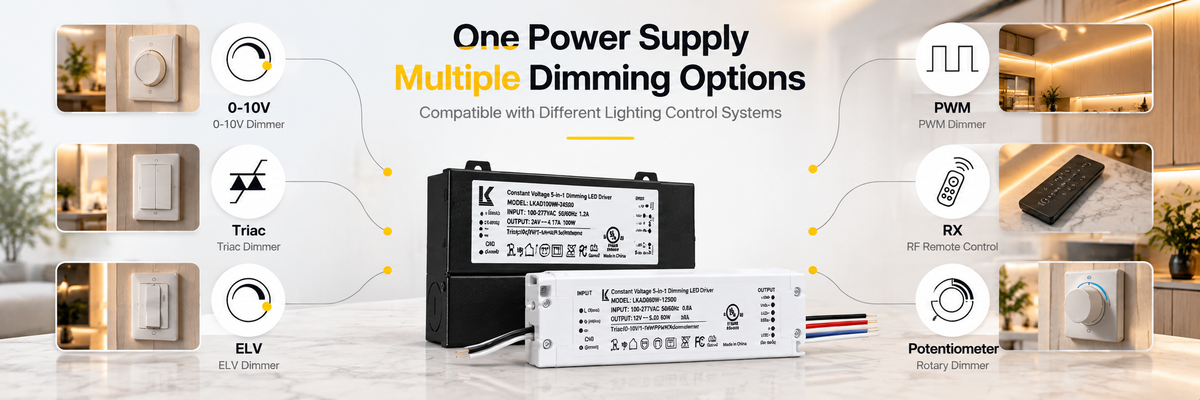
5-in-1 Dimming Compatibility
Supports multiple dimming control methods, including Triac, ELV, 0–10V, PWM and potentiometer dimming systems for flexible lighting projects.

12V & 24V DC Output Options
Available 12V DC and 24V DC models make it easier to match different low-voltage LED strip and cabinet lighting systems.

Multiple Wattage Choices
Choose from 30W, 48W, 60W, 100W and 200W options to support small ambient lighting runs or larger LED strip installations.

Steel & Plastic Case Designs
Steel case models are suited for heavier-duty commercial-style projects, while plastic case models are lighter for residential or indoor installations.
UL / ETL Listed Options
Selected models are listed as UL or ETL, helping support safer and more reliable LED driver selection for lighting projects.

Made for Dimmable LED Applications
Designed for LED strip lighting, under cabinet lighting and home ambient lighting where dimmable low-voltage power is required.
Questions, projects & expert answers
Explore real customer questions, application ideas and answers from our team.
Featured discussion · Application case
A cleaner way to control our 24V kitchen lighting
A simpler 24V backyard lighting setup
Answered by LightingWill
Official answer

July 25, 2024
Answered by LightingWill
What does “5-in-1 dimmable” actually mean on an LED driver?
One driver designed around several common dimming systems

July 25, 2024
Buying guide
Steel case or plastic case — does the housing make a practical difference?
Choose around installation space and how heavy-duty the project is
Customer question
Should I choose the driver first or match it to the LED strip voltage?
The LED load determines the required output voltage
No discussions in this category yet.
Application case
Lighting Specialist
A cleaner way to control our 24V kitchen lighting
The LED strips under our kitchen cabinets had been there for a couple of years, but they were powered by a basic 24V supply so they were either fully on or fully off.
When we changed the switches in the kitchen I decided to replace the power supply too.
I used the 100W 24V dimmable driver and connected the cabinet lighting to the wall dimmer.
That made a bigger difference than I expected. Full brightness is useful while cooking, but in the evening we usually leave the lights much lower so they work more like ambient lighting.
The driver itself is hidden in the cabinet above the refrigerator, so nothing really changed visually except that the lighting is much more usable now.
Answered by LightingWill
Lighting Specialist
Thanks for sharing the project.
The current 100W 24V Steel Case 5-in-1 Dimmable LED Driver provides constant 24V DC output and supports Triac, ELV, 0-10V, PWM and resistive dimming control. It accepts AC120–277V input and is UL Listed. LightingWill lists under-cabinet lighting, LED strips, ambient lighting and display lighting among its intended applications.

Official answer
July 25, 2024
Lighting specialist
What does “5-in-1 dimmable” actually mean on an LED driver?
July 25, 2024
“5-in-1” describes the different dimming-control methods supported by the driver.
It does not mean the output voltage changes automatically or that one driver can power every type of LED strip.
Answered by LightingWill
Lighting specialist
The current LightingWill 5-in-1 drivers support:
Triac
Common with phase-cut wall dimmers.
ELV
Electronic low-voltage dimming control.
0-10V
Frequently used in architectural and commercial lighting-control systems.
PWM
Pulse-width modulation control.
Resistive / potentiometer-style control
Manual variable-resistance dimming control.
The current product pages specify these five control methods across both Steel Case and Plastic Case models.
The driver still needs to match the LED system’s output voltage and total load. A 12V driver should be paired with a compatible 12V load, while a 24V driver should be used with a compatible 24V load. The collection currently contains both 12V and 24V products.
Buying guide
Lighting specialist
 30W 12V DC Plastic Case Triac Dimmable LED Driver, ETL Listed, AC 120-277V Input, LED Driver for LED Strip Lighting / Under Cabinet Lighting / Home Ambient Lighting
View product →
 60W 12V DC Steel Case Triac Dimmable LED Driver, UL Listed, AC 120-277V Input, LED Driver for LED Strip Lighting / Under Cabinet Lighting / Home Ambient Lighting
View product →
Steel case or plastic case — does the housing make a practical difference?
I’m putting dimmable 12V strips into a built-in media unit.
The power supply will be hidden inside the cabinet, so I’m trying to decide whether there’s any reason to use the steel version instead of the smaller plastic one.
The lighting load isn’t very large.
Is the main difference just the housing?
Answered by LightingWill
Lighting specialist
The biggest practical difference is the enclosure and the type of installation it suits.
LightingWill positions the Steel Case models for users who want a stronger and more durable housing structure.
The Plastic Case versions are lighter and better suited to compact indoor installations where easier handling and smaller installation space are priorities.
Both types in the current range support the same core 5-in-1 dimming concept, so the housing choice should be based mainly on installation space, wiring layout and project requirements rather than assuming one housing changes the basic dimming functions.
 30W 12V DC Plastic Case Triac Dimmable LED Driver, ETL Listed, AC 120-277V Input, LED Driver for LED Strip Lighting / Under Cabinet Lighting / Home Ambient Lighting
View product →
 60W 12V DC Steel Case Triac Dimmable LED Driver, UL Listed, AC 120-277V Input, LED Driver for LED Strip Lighting / Under Cabinet Lighting / Home Ambient Lighting
View product →
Customer question
Lighting specialist
Should I choose the driver first or match it to the LED strip voltage?
I’m planning LED strips around several shelves and haven’t bought any of the components yet.
I see almost identical dimmable drivers in both 12V and 24V.
Is there any reason to choose the power supply first and then buy the strip to match it, or should the LED strip determine which driver I need?
Answered by LightingWill
Lighting specialist
The output voltage of the driver must match the LED load.
If you choose a 12V LED strip, use a compatible 12V DC driver.
If you choose a 24V LED strip, use a compatible 24V DC driver.
For example, the current 60W Steel Case model is offered as a dedicated 12V version, while the 100W Steel Case model is also available as a dedicated 24V version. Both accept AC120–277V on the input side, but their DC output voltage is different.
For a new system, decide on the LED strip voltage and installation requirements first, then size the driver around that load.
Lighting Stories & Guides
Product demos, buying guides, installation tips, and lighting inspiration for real projects.

5-in-1 Dimmable Power Supplies
Why More Lighting Projects Are Switching to 5-in-1 Dimmable LED Drivers
Walk into almost any modern lighting project today, and you'll find one challenge that comes up again and again: compatibility. Lighting designers, electricians, and homeowners...
Read & watch → 5-in-1 Dimmable Power Supplies
24V DC 5-in-1 Dimmable LED Power Supply Demo | 100W Waterproof LED Driver | LightingWill
24V DC 5-in-1 Dimmable LED Power Supply Demo | 100W Waterproof LED Driver Watch the 24V DC 5-in-1 dimmable LED power supply in action. This...
March 19, 2026
View story
 5-in-1 Dimmable Power Supplies
12V DC 5-in-1 Dimmable LED Power Supply Demo | 200W Waterproof LED Driver | LightingWill
12V DC 5-in-1 Dimmable LED Power Supply Demo | 200W Waterproof LED Driver Watch the 12V DC 5-in-1 dimmable LED power supply in action. This...
March 19, 2026
View story

JUST ARRIVED
New LED Aluminum Channels
Fresh Designs. Seamless Lighting.
Meet our latest LED aluminum channel additions, designed to bring a clean, modern finish to your lighting projects.
DISCOVER NOW
LIMITED-TIME OFFER
Special Series Savings
Great lighting, special pricing.
Discover this period's featured lighting offers.
Check the applicable products and promotion details before ordering.