
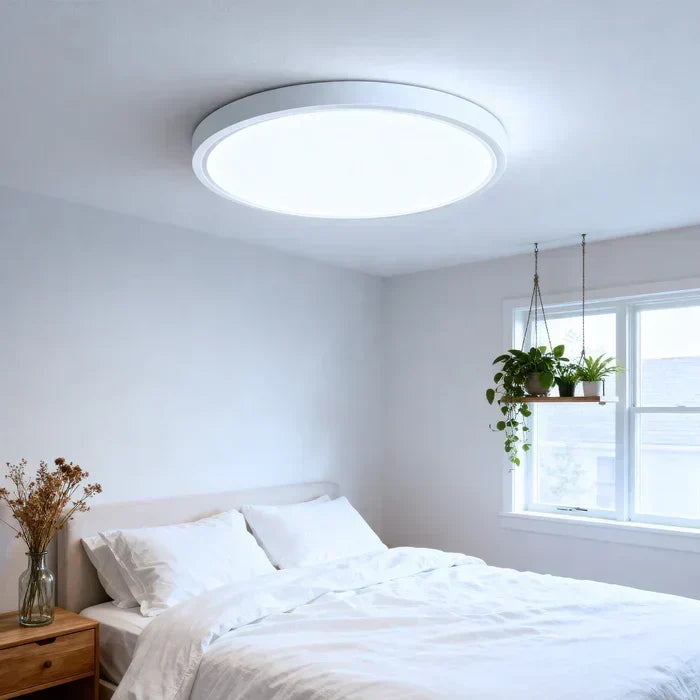
Slim LED ceiling lights have become a practical choice for modern residential and commercial interiors. Their low-profile design helps create a cleaner ceiling appearance while providing general room illumination without the visual bulk of many traditional ceiling fixtures.
They are commonly used in apartments, houses, hotels, offices, hallways and other indoor spaces where a simple flush-mount design is preferred.
What Are Slim LED Ceiling Lights?
Slim LED ceiling lights are low-profile fixtures designed to mount close to the ceiling surface. They are also commonly described as flush-mount or surface-mounted LED ceiling lights.
Many models use an integrated LED light source rather than a replaceable bulb. This allows the fixture to remain relatively thin while reducing the need for routine bulb replacement.
Depending on the model, the diffuser and internal optical design can also help distribute light more evenly across the room.
Why Choose a Slim LED Ceiling Light?
The main advantage of a slim ceiling light is its compact appearance.
Because the fixture sits close to the ceiling, it can work particularly well in rooms with lower ceilings or interiors where a simple and unobtrusive lighting style is preferred.
LED technology can also provide good energy efficiency compared with many older lighting technologies, although actual power consumption depends on the wattage and design of the specific fixture.
Integrated LED ceiling lights can also reduce routine maintenance because there is no conventional replaceable bulb inside many models.
Choosing the Right Color Temperature
Color temperature has a noticeable effect on how a room feels. Depending on the model, slim LED ceiling lights may be available in several white-light options.
- 3000K Warm White: softer and warmer light that works well in bedrooms, living rooms and relaxed residential spaces.
- 4000K–4500K Natural White: a more neutral appearance suitable for everyday lighting, kitchens, hallways and work areas.
- 5000K Daylight White: a brighter and crisper appearance for spaces where clearer white light is preferred.
- 6000K–6500K Cool White: a noticeably cooler white tone that may suit utility areas, offices and selected commercial interiors.
Some ceiling lights may also offer selectable or adjustable color temperature options. Always check the exact product specification before assuming that a fixture supports multiple CCT settings.
Round vs Square LED Ceiling Lights
Shape is mainly a design decision, but it can influence how the fixture fits the architecture of the room.
Round Ceiling Lights
Round fixtures create a softer visual impression and are commonly used in bedrooms, living rooms, entry areas and other residential spaces.
Square Ceiling Lights
Square fixtures create a more geometric appearance and can work well in modern kitchens, hallways, offices and commercial interiors.
The better choice depends on the fixture size, room layout and surrounding interior design rather than shape alone.
Choose the Right Size for the Room
Fixture size should be considered together with room dimensions and ceiling layout.
A compact ceiling light may suit a hallway, closet or small bedroom, while a larger fixture may be more appropriate for a living room, kitchen or open interior area.
Before ordering, check:
- Overall fixture diameter or width
- Fixture thickness
- Mounting-base dimensions
- Ceiling space
- Room size
- Number of fixtures being installed
A fixture that is too small may look out of proportion in a large room, while an oversized ceiling light can dominate a compact space.
Think About Wattage and Light Output
Wattage tells you how much electrical power the fixture uses, but it should not be treated as the only indicator of how well a room will be illuminated.
When comparing ceiling lights, consider:
- Wattage
- Fixture size
- Light output where specified
- Room dimensions
- Ceiling height
- Wall and floor colors
- Whether the room has other light sources
A small hallway and a large living room will not require the same lighting layout.
Where Can Slim LED Ceiling Lights Be Used?
Slim ceiling lights are suitable for many indoor spaces because their low-profile design does not take up much visual space.
Common applications include:
- Residential homes and apartments
- Bedrooms
- Living rooms
- Kitchens
- Dining areas
- Hallways
- Stair landings
- Home offices
- Hotels
- Rental properties
- Retail and commercial interiors
The correct fixture still depends on the room size, required brightness and exact product specifications.
Slim Ceiling Lights for Bedrooms and Living Rooms
Bedrooms and living rooms often benefit from softer white light and a fixture that blends naturally into the ceiling.
A warm-white or neutral-white ceiling light can provide everyday illumination while keeping the room visually simple.
If the room also uses table lamps, wall lights or floor lamps, the ceiling fixture can act as the main general light while the other fixtures provide additional layers of illumination.
Slim Ceiling Lights for Kitchens and Work Areas
Kitchens and work-oriented spaces often benefit from a more neutral or crisp white appearance.
However, the ceiling light should not necessarily be the only light source in a kitchen.
Under-cabinet lighting, task lighting and other localized fixtures can help illuminate countertops and preparation areas more effectively than relying only on one central ceiling fixture.
Slim Ceiling Lights for Hallways and Apartments
One of the strongest applications for a slim ceiling fixture is a space with limited ceiling height.
Hallways, apartments and smaller rooms may not have enough visual space for a large pendant or deep ceiling fixture.
A flush-mounted design keeps the light close to the ceiling and helps maintain a cleaner, less crowded appearance.
Installation Considerations
Installation requirements vary by fixture and building wiring.
A typical flush-mount ceiling light installation may involve:
- Turning off power to the circuit.
- Securing the mounting plate or base to the ceiling or electrical box.
- Connecting the fixture according to the product wiring instructions.
- Securing the light fixture to the mounting base.
- Testing the fixture after installation is complete.
Electrical installation should follow the manufacturer's instructions and applicable local electrical codes. Where mains-voltage wiring is involved, installation should be completed by a qualified person where required.
Check Whether the Light Is Dimmable
Do not assume that every integrated LED ceiling light is dimmable.
Some fixtures are designed only for standard on/off operation, while selected models may support compatible wall dimmers or other control methods.
If dimming is important, confirm:
- Whether the fixture is dimmable
- What type of dimmer is supported
- Whether an existing wall dimmer is compatible
Using an incompatible dimmer can cause poor performance such as flickering or limited dimming range.
Check the Fixture Rating for the Installation Area
A standard indoor ceiling light should not automatically be installed in a bathroom, covered outdoor area or other location where moisture may be present.
If the installation environment requires moisture protection, check the exact IP rating or location rating of the selected fixture.
Do not assume that every slim ceiling light in a collection has the same protection level.
Maintenance and Cleaning
Integrated LED ceiling lights generally require relatively little routine maintenance.
For normal cleaning:
- Turn off power before cleaning the fixture.
- Use a soft, dry or slightly damp cloth where appropriate.
- Avoid aggressive cleaning chemicals unless permitted by the manufacturer.
- Keep vents or openings free from excessive dust.
- Do not disassemble the fixture unless the product instructions allow it.
The exact service life and maintenance requirements depend on the fixture design, operating conditions and individual product specifications.
Common Buying Mistakes
Choosing by Wattage Alone
Wattage is only one specification. Room size, fixture design and actual light output also matter.
Assuming Every Model Has Adjustable Color Temperature
Some fixtures provide multiple CCT options, while others use one fixed color temperature.
Ignoring Fixture Dimensions
Check the actual diameter or width and thickness before ordering.
Assuming Every LED Ceiling Light Is Dimmable
Dimming support depends on the specific model.
Using a Standard Indoor Fixture in a Damp Location
Always confirm the exact protection rating for the intended environment.
Mixing Very Different Color Temperatures
A small room can look visually inconsistent when very warm and very cool fixtures are used together without planning.
Final Checklist
- What room will the ceiling light be used in?
- How large is the room?
- What fixture size fits the ceiling?
- Which color temperature suits the space?
- How much light is required?
- Is the fixture round or square?
- Does the project require dimming?
- Does the installation area require an IP-rated fixture?
- Does the fixture match the available electrical system?
- Will additional task or accent lighting also be needed?
Conclusion
Slim LED ceiling lights are a practical option for modern interiors where a clean, low-profile fixture is preferred.
Rather than choosing only by appearance or wattage, compare fixture size, color temperature, light output, dimming capability and installation requirements.
Matching the fixture to the actual room and intended use will produce a more comfortable and visually balanced lighting result.

Commenta
Questo sito è protetto da hCaptcha e applica le Norme sulla privacy e i Termini di servizio di hCaptcha.